The First Loss, AI Bot Martingale on Pocket Option ($500 Trades) Shows Exactly What One Recovery Step Costs
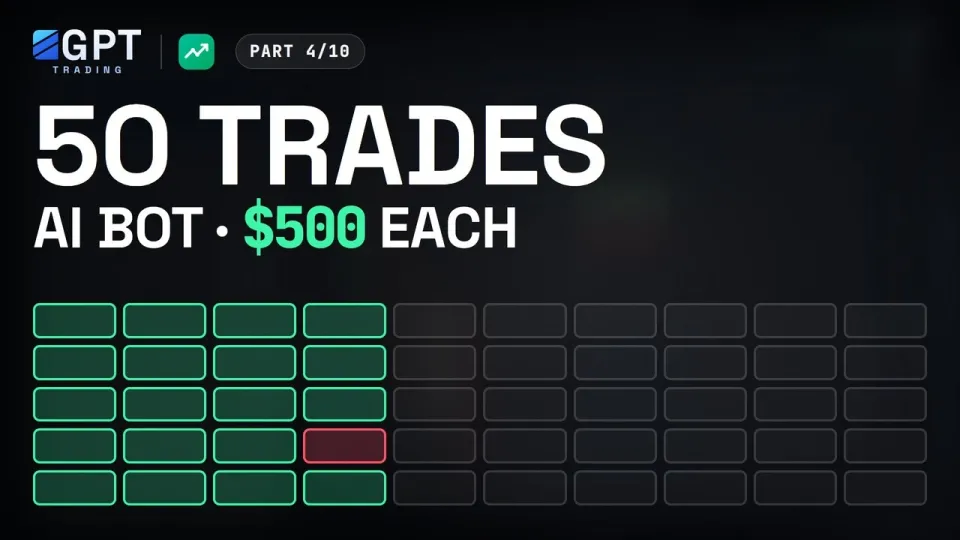
Video: The First Loss: AI Bot Martingale on Pocket Option ($500 Trades) | Part 4/10
· based on the channel GPT Trading BOT | Pocket Option Auto Trading
Key takeaways
- Part 4 of 10 covers trades 16–20 of a 50-trade session with $500 fixed stakes on Pocket Option.
- Trade 19 was the first loss of the session: −$500.
- Trade 20 was the single Martingale step: $1,100 stake, +$1,012 payout.
- Part 4 result: 4 wins, 1 loss, +$1,892 over trades closed between 18:20 and 18:25.
- Balance moved from $45,175.44 to $47,067.44, taking the session total to +$8,792.
The first loss of the session came on trade 19 and cost $500; trade 20 was the one-step Martingale recovery, staking $1,100 and returning +$1,012, so part 4 of the Pocket Option AI bot marathon closed at 4 wins, 1 loss and +$1,892. The balance moved from $45,175.44 to $47,067.44, taking the running session total to +$8,792 — and you can test the same GPT Auto Trading setup for free before risking real money.
This is part 4 of a 10-part recording: 50 trades, one uninterrupted session, $500 per deal, no restarts. The segment covers trades 16 through 20, all closed between 18:20 and 18:25.
What one step of Martingale really does on a $500 stake
A one-step Martingale means the bot is allowed exactly one recovery trade after a loss, and that trade is sized to win back the lost stake plus the original profit target in a single hit. On a $500 base stake with a typical binary payout, that means roughly doubling the position — here $1,100 — so the winning payout of $1,012 covers the $500 hole and still leaves a gain.
The mechanics matter more than the label. With a single step, the bot never chains three or four doublings together, so the worst case for a sequence is one enlarged trade, not an exponential ladder. The trade-off is equally clear: the recovery trade carries more than twice the exposure of a normal deal, and if it loses, the drawdown is the sum of both stakes.
In this session the settings were Gold status, Performance mode, deal time of 30 seconds to 1 minute, auto-selected currency pair, $500 trade amount, one-step Martingale and a 50-trade limit. The bot runs in the cloud, syncs without any terminal setup, and cannot open deals without the account holder's permission.
Trade 19: the first red close of the session
Trade 19 was the first loss of the entire run, a clean −$500 that broke a streak of green closes. Nothing in the recording suggests a malfunction: the bot placed the deal under the same rules as trades 1 through 18, and the outcome simply went against the position.
That single number is the most useful data point in the part. It shows the real cost of a $500 unit: one miss erases the profit of one winning trade, so the session's edge depends entirely on the win rate staying above the break-even threshold implied by the payout. At a payout near 92%, a trader needs roughly 52% accuracy just to stay flat before any recovery logic is applied.
Trade 20: the $1,100 Martingale recovery
Trade 20 was the one permitted Martingale step: a $1,100 stake that closed green for +$1,012. The arithmetic is straightforward — the $1,012 payout more than offsets the $500 lost on trade 19, netting about +$512 across the pair compared with roughly +$460 from two plain $500 wins.
The recovery worked, but the exposure profile is worth stating plainly. Risk on that single deal was $1,100, or 2.2 times a standard position, on an account balance of about $45,000 — under 2.5% of equity, which is manageable. On a $1,000 account, the same $1,100 stake would be impossible, which is why the one-step structure only makes sense when the base stake is a small fraction of the balance.
Part 4 by the numbers
Four wins and one loss produced +$1,892 across five trades, with all deals closing inside a five-minute window between 18:20 and 18:25. The table below summarizes the segment.
- Trades covered: 16–20 (5 deals)
- Wins / losses: 4 / 1
- Worst trade: trade 19, −$500
- Largest stake: trade 20, $1,100
- Part result: +$1,892
- Balance before: $45,175.44
- Balance after: $47,067.44
- Session total so far: +$8,792
Averaged over the five trades, that is about $378 of profit per deal, well above the $460-per-win figure you would get from pure fixed staking without the recovery step — a reminder that the Martingale layer is doing real work in this sample, and also that the sample is five trades long.
Why the first loss is the part worth watching
A lossless run tells you almost nothing about a trading bot; the first red trade tells you how the risk model behaves under pressure. Here the sequence was textbook: one loss, one enlarged recovery, back to the base stake. No second Martingale step was triggered because none was permitted by the settings.
Three things to check in any similar session before drawing conclusions:
- Whether the recovery stake stays a small percentage of equity — at $1,100 on $45,175 it is about 2.4%.
- Whether the bot returns to the $500 base stake immediately after a successful recovery, rather than staying elevated.
- Whether a losing recovery trade would still leave the account within its planned drawdown, since that is the scenario a one-step Martingale cannot absorb.
Gold status activates automatically once the Pocket Option balance exceeds $300 and unlocks automated risk management and Performance mode; the 50-trade cap used here is a self-imposed limit, since Gold accounts have no deal limits imposed by the bot itself.
Session links and where to follow the marathon
The full recording series and the bot's documentation are collected in one place:
- Free trial and registration: https://gpt-trading.app/landing/go?vid_6VBsYhlTI6Y (promocode GPT100 doubles the deposit)
- GPT Trading Club, reviews and news: https://t.me/gpt_trading_club
- Official website: https://gpt-trading.io
- Playlist with parts 1–10 in order: https://www.youtube.com/playlist?list=PLD-wibqLCCes
The takeaway from part 4
The first loss arrived on trade 19 and was fully absorbed by a single $1,100 Martingale trade that paid $1,012, leaving part 4 at +$1,892 and the session at +$8,792 on a $47,067.44 balance. The structure worked as designed, but the recording also shows the honest cost of the method: one enlarged deal carries more than double the risk of a normal position, and that risk only stays comfortable when the base stake is small relative to equity. Trades 21–25 continue the marathon in the next part. The breakdown was produced by the channel GPT Trading BOT | Pocket Option Auto Trading, and you can start a free GPT Auto Trading session to see the settings for yourself. Trading involves risk of loss, and past results from a recorded session do not guarantee future performance.
Questions & answers
How much did the first loss cost in the Pocket Option AI bot session?
Trade 19 closed in the red for exactly −$500, the first losing trade of the 50-trade run. It was immediately followed by the single permitted Martingale step, a $1,100 stake that returned +$1,012.
What does one-step Martingale mean in these settings?
It means the bot may place exactly one recovery trade after a loss, sized to recover the lost stake plus the original target — here $1,100 versus the $500 base. If that recovery trade loses, no further doubling occurs, and the drawdown is the sum of both stakes.
What was the result of part 4?
Trades 16–20 produced 4 wins and 1 loss for +$1,892, with all deals closed between 18:20 and 18:25. The balance rose from $45,175.44 to $47,067.44, bringing the session total to +$8,792.
Do I need a large balance to run $500 trades with this bot?
Yes, practically speaking. A $1,100 recovery stake is about 2.4% of a $45,000 balance but would exceed a small account entirely, so the base stake must stay a small fraction of equity for the one-step structure to be survivable.
Source: The First Loss: AI Bot Martingale on Pocket Option ($500 Trades) | Part 4/10 · Markdown version