Meme coin entry strategy
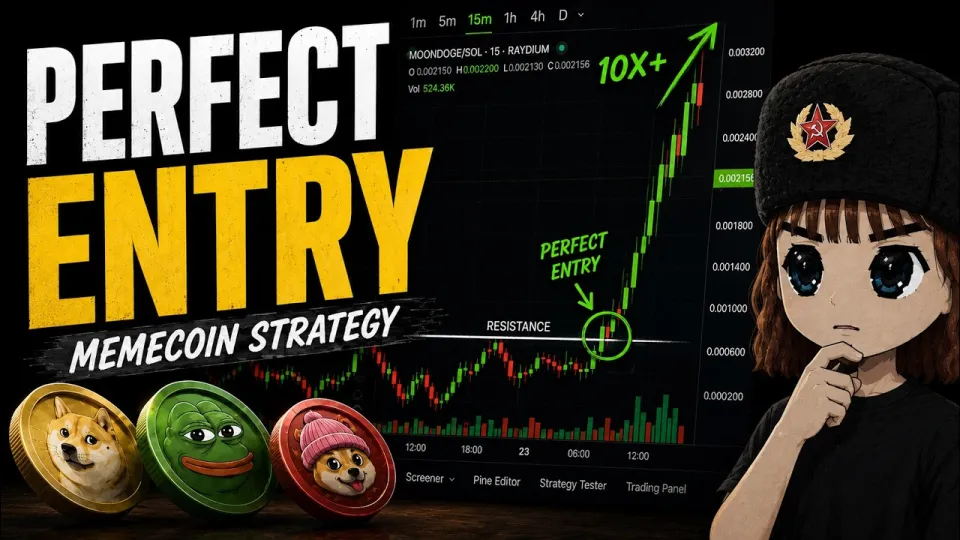
Video: How I Find the PERFECT Entry on Memecoins 📈 (Full Strategy)
Need articles like this for your video? They help promote it on YouTube and Google — order them in the Telegram bot @sat_sit_bot. It writes articles around your video, embeds the video and publishes them on popular niche websites (no ads). Your first 50 articles are free.
· based on the channel starwifpump
Key takeaways
- Most meme coin losses come from timing, not from picking the wrong token: entering after a vertical green candle destroys the risk-to-reward ratio.
- A quality entry needs three confirmations: structure (higher lows), volume expansion and a retest of a broken level.
- Buying a pullback to support typically offers a tighter stop than chasing a breakout, which improves the reward-to-risk multiple.
- Invalidation signals before entry: fading volume on new highs, long upper wicks, a lower high after a failed breakout and a stalled narrative.
- Risk is planned before the trade: position size, stop level and partial profit-taking levels are defined in advance, not improvised.
A meme coin is a highly volatile crypto token whose price is driven mainly by narrative, liquidity and social attention rather than fundamentals, so the entry point matters more than the pick itself. The practical answer to "when do I buy" is: after momentum is confirmed, on a pullback into a level that was already broken, with a predefined stop and position size. Chasing a vertical candle is not an entry — it is a transfer of your money to earlier buyers. A free toolset for paper trading, sniping and position tracking is available through the Plasma Telegram early-access channel.
The breakdown below follows the framework shown by the starwifpump channel in the video "How I Find the PERFECT Entry on Memecoins" — a process built around chart structure and patience instead of FOMO.
Why the meme coin entry point decides the outcome
Entry price sets the entire math of a trade: the same token can be a 3R setup or a guaranteed loss depending on where you clicked buy. If a token has already run 400% in fifteen minutes, your stop has to sit far below the current price, which means a small position or an unacceptable loss. Entering on a controlled pullback compresses the distance between entry and invalidation, so a normal 10–20% shakeout does not stop you out before the move continues. This is why experienced traders treat the chart as a timing tool and the narrative as a filter, not the other way around.
Memecoins on Solana and similar chains can print enormous percentage moves within minutes, and liquidity is thin enough that a single large seller can wipe out a candle. That asymmetry is exactly why entry discipline, not prediction, is the repeatable edge.
The pre-entry checklist before buying any meme coin
Before looking at a chart setup, confirm that the token is even tradeable: liquidity locked or burned, mint authority revoked, holder distribution not dominated by a handful of wallets, and social activity that is organic rather than a wall of copy-paste replies. A perfect technical entry on a token with a live mint function is still a bad trade. Then move to the chart and answer four questions in order: is there a clear structure of higher lows, has volume expanded on the up-moves, is there an obvious level that price has already respected twice, and where does the setup get invalidated? If any answer is missing, there is no trade.
Setups worth waiting for: momentum, breakouts and pullbacks
The highest-quality meme coin entries come from three repeatable patterns rather than from a hunch.
- Momentum continuation. Price makes a higher low after an impulse, volume stays above its recent average, and the next candle breaks the previous high. Entry goes on the break or on the first small retest, stop under the higher low.
- Breakout and retest. A token consolidates under a horizontal level for a while, breaks it on expanding volume, then returns to test that level from above. The retest is the entry; the failed retest is the exit signal.
- Pullback into support. After a strong first leg, price drifts back to a moving average or a prior consolidation zone on declining volume. Declining volume during the pullback is the confirmation that sellers are exhausted, not in control.
In all three cases the rule is identical: you buy strength that has paused, never strength that is still accelerating. A candle that is already vertical gives you no logical place for a stop.
Signals that say do not enter
Most losing meme coin trades are avoidable at the moment of decision, because the chart usually warns you first. Skip the trade when volume fades while price makes a new high, when a breakout candle leaves a long upper wick and closes back inside the range, when price prints a lower high after failing to reclaim a level, or when the whole move depends on a single influencer post with no follow-through buying. Also skip tokens where the bid-side liquidity is thin enough that your own order moves the price several percent — you will not be able to exit at the level you planned.
A stalled narrative is a chart signal too: if social mentions are falling while price chops sideways, the next move is more often down than up.
Planning risk, exits and profit-taking before the click
Risk management is decided before entry, not after the position goes red. Define the invalidation level first, then size the position so that hitting it costs a fixed, small percentage of your account — commonly 1–2% per trade for this asset class. Set partial exits in advance: many traders scale out a third or a half into the first strong extension, move the stop to breakeven, and let the remainder run with a trailing stop. That structure converts a volatile meme coin position into a managed one, and it removes the emotional decision-making that ruins otherwise good entries.
Common questions from newer meme coin traders
Beginners tend to ask the same things, and the answers are consistent regardless of the chain. Which chain is best? The one with the liquidity and the tooling you actually understand — Solana dominates memecoin volume, but the entry logic does not change between chains. What filters should a tracker use? Typically minimum liquidity, minimum holder count, age of the pool and volume-to-market-cap ratio, so you see live candidates rather than dead tokens. How do you catch a token before a social-driven pump? You do not need to: waiting for the first confirmed impulse and buying the retest captures most of the move with a fraction of the risk. And what if you have already lost money? Reduce size, trade only setups you can describe in one sentence, and paper trade until the process is boring.
Useful links
- Plasma Telegram — early access, updates and setup help
- starwifpump Discord community
- Padre trading terminal
- Solpump
- starwifpump on X
Bottom line
A meme coin entry is a decision about distance to invalidation, not a prediction about the future. Confirm structure, wait for volume, buy the pause rather than the spike, and size the position so a normal shakeout is survivable. The starwifpump channel built its full strategy around exactly this sequence, and the framework holds whether you trade Solana memecoins or any other volatile chain. If you want the same toolset for paper trading, sniping and tracking positions in one place, start with the Plasma Telegram early-access channel.
Questions & answers
What is the best time to enter a meme coin?
After momentum is confirmed and price pulls back into a level it has already broken or respected. Buying the pause instead of the vertical candle keeps the stop close and the reward-to-risk ratio favorable. Entering during acceleration leaves no logical invalidation point.
How much should I risk on a single meme coin trade?
A common approach is 1–2% of the account per trade, with the stop placed at the level that invalidates the setup. Because meme coins can drop 50% or more in minutes, position size should be calculated from the stop distance rather than from how confident you feel.
Do the same entry rules work on every chain?
The chart logic — structure, volume, retests and invalidation — is chain-agnostic. What changes is liquidity and tooling: Solana currently carries most memecoin volume, while smaller ecosystems may have thinner order books and wider spreads, which requires smaller size.
How do I avoid FOMO when a coin is already pumping?
Accept that you will miss some moves and treat a missed trade as a cost of doing business. Keep a written checklist, wait for the retest, and if the setup does not appear, skip it — there is always another token. A predefined entry plan removes the decision from the moment of excitement.
Source: How I Find the PERFECT Entry on Memecoins 📈 (Full Strategy) · Markdown version